

Studying abroad is one of the most transformative decisions a student can take-and for the Indian students, the landscape of global education in 2026 offers more options than ever before. From the research powerhouses of North America to the tuition-free European universities and the rapidly rising East Asian institutions, it is such a welter of choices that could be exciting and tough at the same time.
In this, we will look into the analytics of five most popular and promising destinations for Indian students-the Canada, USA, Germany, Japan, and Australia-based on parameters of education cost, visa process, post-study work rights, and long-term employment opportunities.
1. Canada
 Overview: In recent times, Canada has become a very popular destination for Indian students to study abroad. With its immigration policies being very welcoming to foreign nationals, multicultural cities and a strong job market; this is definitely a top choice for anyone looking to pursue higher education and/or settle down full-time.
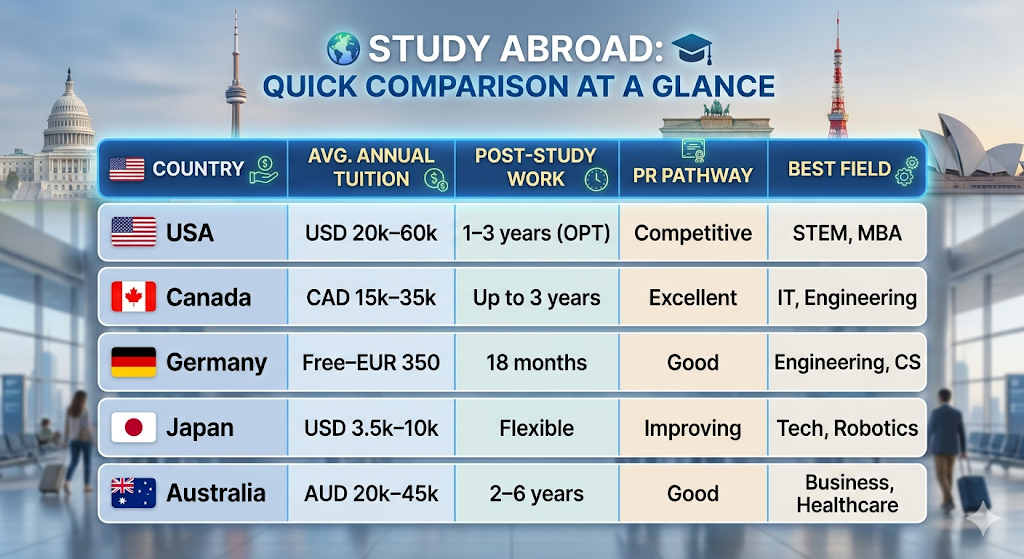
Costs of Education: Tuition fees range from CAD 15,000 - 35,000 on average per year. Students will find the cost of living in Canada also varies but is usually close to CAD 10,000 - 15,000 per year. Some of the best universities offering excellent education at an affordable price include the University of Toronto, the University of British Columbia, and McGill University.
Visa Requirements: If you want to be able to study in Canada as an international student from India, you will need to apply for a study permit (Canadian Study Visa). In order to apply for this type of visa you are required to provide an acceptance letter from a Canadian Designated Learning Institution. Recently, the IRCC has implemented some changes which have resulted in more efficient processing times.
Post-Study work and employment options: International students can apply for their Post-Graduation Work Permit (PGWP) which provides them with the opportunity to gain Canadian work experience for up to 3 years after completing their degree or diploma. After acquiring Canadian work experience, students can apply for Canadian Permanent Residency under programs such as Express Entry or the Canadian Experience Class (CEC).
Fields that are most in demand: Information Technology, Healthcare, Engineering, Business Management, Environmental Studies.
2. United States of America
 Overview: The USA is still the number one choice for Indian students opting for higher studies, especially MS/PhD programs in STEM subjects, business studies, etc. American universities like MIT, Stanford University, Harvard, and Carnegie Mellon are among the most renowned around the globe.
Cost of Education:
Tuition Fees: Between USD 20,000 and USD 60,000 annually, depending on the university and the program being pursued by the student.
Living Costs: About USD 12,000-18,000 annually. However, scholarships, teaching assistantships, research internships, etc., make a big difference, especially during graduate studies.
Visa Process: For Indians, the process includes applying for an F-1 Student Visa. It entails getting the I-20 form from your university, paying the SEVIS fee, and attending an embassy interview. The process has been streamlined; however, appointment availability may not be problem-free in some cases due to high demand.
After Study Jobs and Career Prospects: OPT Program: Graduates are eligible to work in the US for a period of 12 months after graduation. If pursuing a STEM course, the duration increases to 36 months.
Best For: MS/PhD in Computer Science, Data Science, MBA, Engineering, Biotechnology.
3. Germany
 Overview: Germany is a great destination for international students looking for quality education. Although most German public universities don't charge international students any tuition fees, the cost of living in larger cities, like Berlin, Munich or Frankfurt will cost around 700 to 1,200 euros per month.
Education Cost: Public universities in Germany do not charge international students tuition to attend, but they do collect small fees (between 150 and 350 Euros) each semester for administrative expenses and services for students. In addition to tuition or fees, students must also pay other costs related to education; therefore, there are two primary expenses to consider, i.e., actual cost of education (tuition, fees, and books) and living costs for 12 months.
Visa Requirements: To study in Germany, Indian citizens need to obtain a Study Visa. When applying for a Visa, you will need to submit, (1) proof of acceptance at a recognized German university; (2) proof of the applicant’s financial ability (an average of €11,200 in an account, called a “blocked account”); (3) proof of having health insurance; and (4) proof of language proficiency (if studying at a German Institution). If your program is taught in English (generally MSc programs) you are exempt from the requirement for proficiency and other requirements.
Job Prospects & Post-Study Work Rights: International graduates from Germany can stay in Germany up to 18 months after they've graduated to job-hunt. In addition, Germany has a critical need for skilled workers (engineering, information technology, and healthcare) so Indian students who graduate will have no trouble finding employment.
Ideal Areas of Study: Engineering, Computer Science, Natural Science and MBA.
4. Japan
 Overview: When Indian students think about studying Japan is not usually the first country that comes to mind. Japan is becoming more popular very quickly. Japan has programs that are taught in English, strong scholarships from the government and a technology and robotics sector that is doing very well. This makes Japan a great place for students to learn and experience a culture.
Cost of Education: The cost of tuition at universities in Japan is around JPY 535,800 each year which is about USD 3,500. This makes Japan an affordable option for students compared to other developed countries. Private universities in Japan cost more around JPY 1,000,000 to JPY 1,500,000 per year. The Japanese government has a scholarship called the MEXT Scholarship, which pays for tuition, living expenses and airfare for students who're eligible.
Visa Process: To study in Japan students need to get a College Student Visa. To get this visa students must first be accepted into an university and then they will get a Certificate of Eligibility from the Japanese immigration office. The whole process is easy to follow. Well explained.
Post-Study Work & Job Prospects: Japan has a problem with its aging population and not having enough workers. Because of this the government is trying to attract international students and workers. After they finish their studies students can easily switch to a work visa. The Japanese government is promoting a program called the Specified Skilled Worker program. It is still helpful to speak Japanese. There are more and more jobs available that only require English.
Best For: Robotics, Engineering, Information Technology, Design, Life Sciences.
5. Australia
 5. Australia
Overview: Australia is a great country for studying, with excellent educational institutions and a laid-back lifestyle. The various cities within Australia are incredibly dissimilar from each other. After finishing your studies, you will find many job opportunities available to you within Australia. Many students from India aspire to study in Australia and internationally recognized universities located here including the universities of Melbourne, Australian National University (ANU), and University of New South Wales (UNSW) consistently rank within the top 100 universities worldwide.
Educational Cost: Studying in Australia can be quite expensive. There is a range of tuition fees depending on what you are studying at university or college, the price of education is generally between AUD 20,000 and AUD 45,000. You will also require approximately AUD 18,000 to AUD 25,000 per annum for living expenses while in Australia. Additionally, you can obtain employment while studying, (therefore helping to offset the overall costs of the tuition). Overall, Australia is an expensive country to study in; however, the quality of education coupled with the ability to gain employment while studying makes the higher cost worthwhile to many individuals.
Visa Process: Students wishing to study in Australia must apply for a Subclass 500 Student Visa. This visa can be obtained if you provide evidence of your enrolment in a course, the financial means to sustain your cost of living while studying (including tuition), English language proficiency, and adequate health insurance. Holders of this visa may work a maximum of 48 hours over a two-week period while enrolled in school.
Post-Study Work Options in Australia: You can apply for a Temporary Graduate Visa after completing your studies in Australia, which allows you to remain in Australia for two to six years (depending upon your field of study and whether you have an Australian qualification) after your graduation date. Australia provides a points-based immigration system that facilitates the pathway for skilled graduates who have skills that are currently in demand to immigrate to Australia as permanent residents.
Fields of study best suited for international students: Business; Finance; Information Technology; (IT); Health Care; Engineering; and Environmental Science. These fields of study are well represented within Australia's university education institutions, and significantly contribute to Australia's overall economy.
 Disclaimer: Visa rules, tuition fees, and immigration policies are subject to change. Always refer to official government and university websites for the most current information