
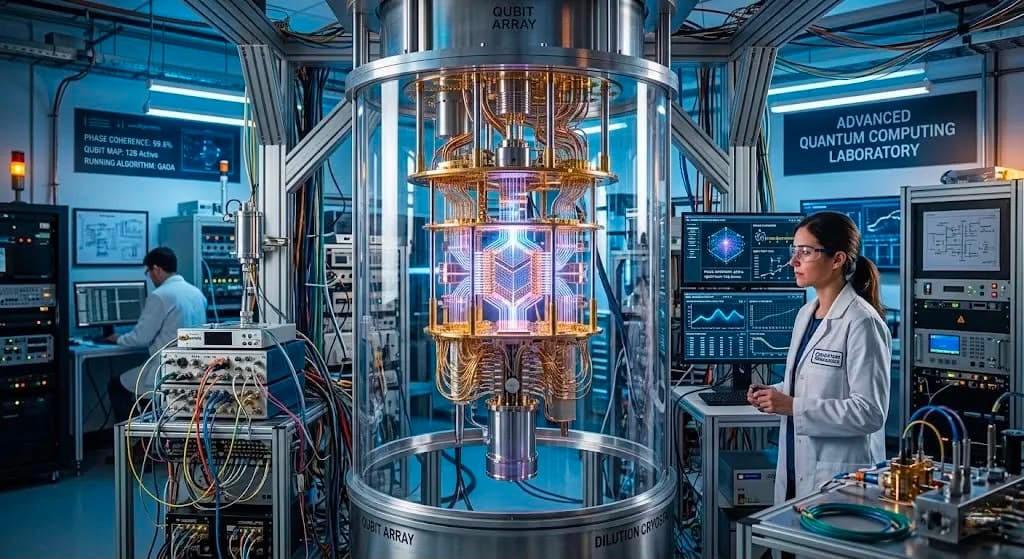
Your smartphone is an incredible piece of engineering; it can stream video, translate languages, predict traffic, and play games at the same time. It can process billions of instructions each second. However, for many types of problems, it's useless. Not because it's too slow or doesn't work properly, but because there's no other way to solve them than to use a completely different type of device. That device is called a quantum computer, and understanding what that means, the reason why it is necessary, and why India should be paying attention to quantum computing has gone from being a totally interesting question to being something that requires immediate action.
To introduce the concept of quantum computers, we will first look at classic computers.
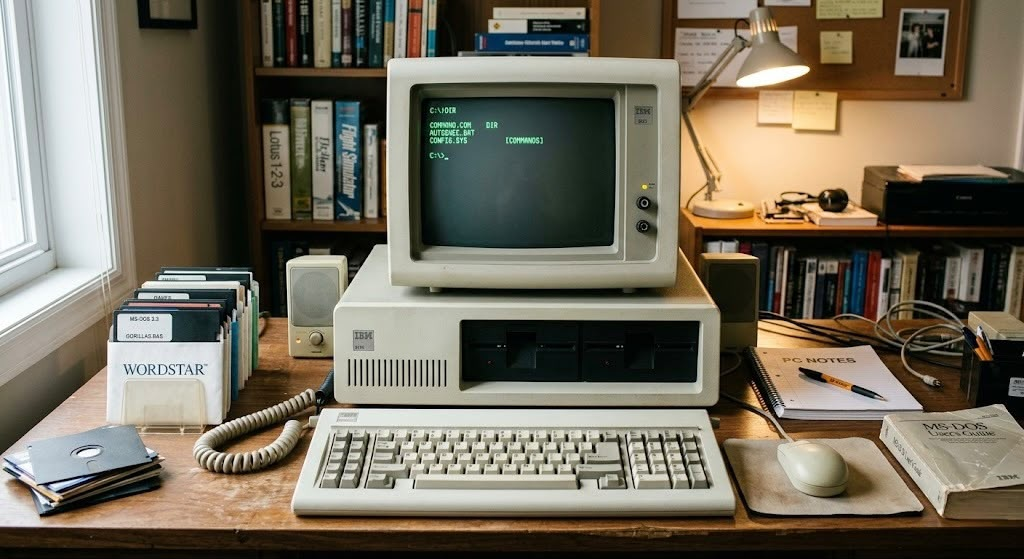 Classic computers process all their data using binary numbers (represented by 0 or 1) referred to as bits. This includes your photos and emails and even your bank balance.
In order for the classic computer to solve any problem, it has either to process all the possible solutions to that problem (in large numbers, called “batches”) or process them over time (that is, one at a time in chronological sequence). So if we want to compute which city route we should take amongst 10 cities, a classic computer can do so very quickly, but when there are 200 cities involved, the potential number of possible routes to consider is much larger; the number of combinations is beyond anything we can imagine, and is more than the total number of atoms anywhere in the universe.
Therefore, when classic computers stop working for us, we use quantum computers to continue solving our problems.
Enter the Qubit: Physics becomes strange
The fundamental unit of a quantum computer is a qubit (quantum bit, if you may). Like in a classic computer, a quantum bit can be a 0 or 1. But, here’s the fun part: thanks to the principles of quantum mechanics, a qubit can be both 0 and 1 – at the same time.
This property is known as superposition.
For instance, take a coin. When it’s flat on a table, it’s either heads or tails, you know the classic bit. But, when you spin it, it’s neither head nor tails precisely, it’s a bit of both simultaneously. And, the moment it stops and falls, it becomes one or the other. So, the qubit is just a spinning coin, existing in multiple states until you try to measure it.
Why does it even matter? Because a quantum computer can process double the states at once. Two qubits can process four and ten can process 1,024. Fifty can process over a quadrillion. Yes, that’s a number. Imagine, the improvement.
This is an entirely different computational power.
The other two Superpowers: Entanglement and Interference
Superposition alone does not really explain the whole thing. There are two other mind-blowing phenomena that make quantum computing revolutionary.
Entanglement is the ability to link the qubits so that one can influence the other, irrespective of physical distance. In Einstein’s words this is called, ‘spooky action in a distance.’ So, in a quantum computer when entangled qubits work in a team, any changes to one of them immediately influences the other which allows quantum computers to work across complex systems in ways that cannot be equivalent to any classical computer.
Interference is the mechanism in which quantum algorithms guide the computer to use the right answer. Quantum states can be manipulated with paths that lead to wrong answers cancel each other out and paths that lead to correct ones support each other. These are called destructive and constructive interference, respectively.
The correct solution rises to the top.
So together, superposition, entanglement and interference give quantum computers an extraordinary edge. But, only for certain types of problems.
What quantum computers are good at, and more importantly what they aren’t exactly good.
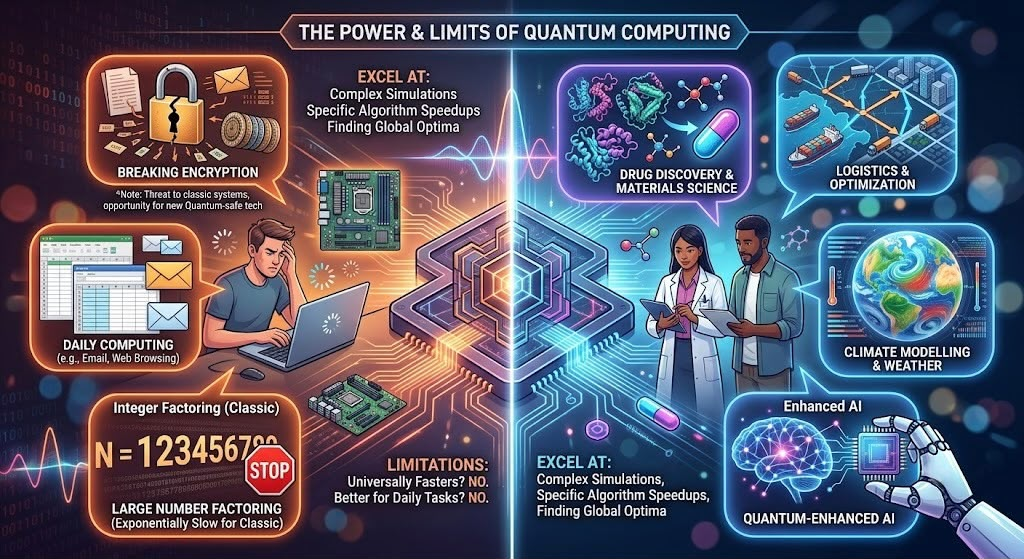 First thing’s first, it is important to understand that quantum computers aren’t universally fasters than classic computers but dramatically faster for a critically important number of problems and win in
Cryptography and Security: So, quantum computers can break encryption that protects financial systems, government communications and even the internet. Just as being a great threat, it is the exact reasons governments are racing to develop quantum-safe encryptions.
Drug Discovery and Materials Science: Simulating molecular interactions is rather impossible for classic computers, but quantum computers can model entire drug and protein compounds, accelerating medical breakthroughs by decades.
Optimization Problems: Talking about logistics, financial portfolios and traffic systems – issues with innumerable combinations, - quantum algorithms can find solutions exponentially faster.
Artificial Intelligence and Machine Learning: Quantum-enhanced AI can process patterns at speeds that can make today’s models look rather primitive.
Climate Modelling: Simulating climate systems with the accuracy that is needed for real invention.
It is also pertinent to understand that quantum cannot replace classical for sending emails, editing documents – the basics – classical computers will remain king for that, at least in the near future.
Where the world stands right now.
Quantum computing is no longer imaginable but rather a legitimate, real and evolving technological field. The first commercial implementations of quantum computers began with experimental ('noisy') designs but are growing rapidly.
IBM currently provides access to a cloud-based quantum computer that operates with more than 1000 qubits. In addition, Google has publicly asserted its ability to perform calculations that would take a supercomputer approximately 10,000 years to perform in just 200 seconds through “quantum supremacy”.
China has made significant investments in quantum research, and some advances have already been made in quantum communications. On the other hand, the United States government has made quantum computing a strategic national priority and is committing resources to develop these types of technologies.
The United States is now competing with other countries in this industry, and it is happening at a rapid pace.
The real question: Why should India care?
India cannot afford to be spectator in the race.
Firstly, India’s digital economy that includes UPI payments, Aadhaar cards and even defense communications, these run on encryption standards that a sufficient quantum computer can crack. The adversaries in India should collect the data today and plan to decrypt it once quantum hardware actually matures. This threat is not hypothetical, and the transition can take years.
Second, India’s generics industry serves billions and quantum computing in drug discover can compress the timeline for a new drug development from more than 10 years fraction of that. Companies that invest in quantum-readiness will lead. Others will have to license and then follow.
Third, while China’s advances are not just commercial, with their quantum radar and communication networks and quantum-enabled cryptanalysis being vigorous military research ideas. And India, cannot afford to stay behind.
India has already launched National Quantum Mission in 2023 with an outlay of 6003 crore rupees over eight years. The mission is to target developing intermediate-scale quantum computers, communication networks between cities and quantum sensing. Big institutions such as the IISc and C-DAC are already actively involved.
This is a start and it needs to be more than just a policy document lying somewhere. What is needs is execution and genuine industry-academic collaboration. You don’t need to understand the nitty gritty of quantum mechanism but just understand how Indian stakeholders should respond.
Students and early-career professionals should take an interest in quantum computing. As it needs physicists, computer scientists and engineers. Courses on quantum computing should be introduced through MIT Open Courseware and even IITs. Getting in earlier into quantum computing is an obvious advantage.
If you’re an entrepreneur, you can start conversations with your IT and security teams about quantum-cryptography. The US National Institute of Standards and Technology has already finalized quantum-resistant encryption standards in 2024 so the migration planning should begin now.
If you become a champion of the National Quantum Mission, not just for the initiative but to serve the infrastructure, something every economy relies on – you can be a part of history.
If you can’t be any one of these, just understand that quantum transition will change and reshape geopolitics, healthcare, finance and basically everything in your lifetime. Being informed is the start – and you’ve already taken the first step by reading this.
Quantum computing is no bluff. It’s a real revolution coming sooner than you realize yet later than you’re ready.
For India, the stakes are even greater. The nation’s digital architecture, artificial intelligence, pharmaceuticals, and defense capabilities are all linked to quantum computing in significant ways.
Certainly, The National Quantum Mission sounds encouraging, but it’s vital to invest and to recruit some of the best academics in the field.
Qubits might be tiny. But their impact sure isn’t.